Some time ago, we shared a story of a puzzling newspaper clipping hidden in the National Library of Scotland in the Traverse Theatre Collections — the review of a first Writers About showcase that happened on 22 June 1990 that hinted at early roots of Class Act. With the help of the British Library News Room London experts this discovery set the tone for what happened next.
The Licensing Loop‑the‑Loop
Our latest attempt to verify the rights to store and present Julie Morrice's article “From Jotter to Stage” (Times Scottish Educational Supplement, 29 June 1990, p. 21) sent us first to the British Library, who directed us to the News Licensing Company. After conducting their own investigation, the NLC confessed that they had sold the Scottish TES roughly fifteen years ago and no longer held any rights to it. That unexpected revelation leaves us waiting for the TES editorial team to respond to our enquiry — a small cliff‑hanger in a long paper chase.
A Week of Old Stories
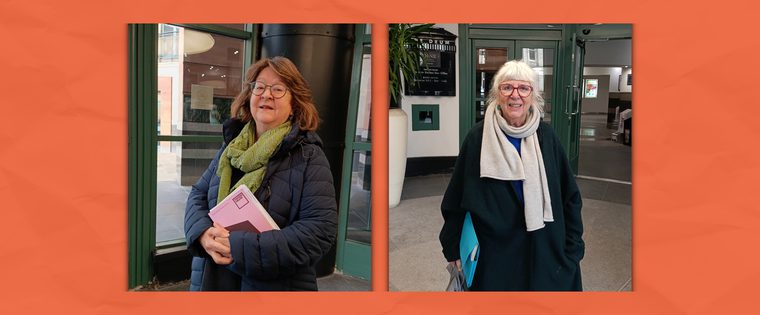
While the licensing trail curled back on itself, something far richer opened up in its place. Maria Kroupnik (PhD Media, Culture and Heritage) met with two people whose voices and efforts shaped the early life of the Class Act: Jane Ellis and Jenny Wilson. Their memories didn’t just fill in historical blanks — they breathed life into the period when Writers About was first taking shape and later transforming into Class Act in 1993. Listening to them felt like opening a window onto a creative landscape and ideas that laid fundamental bricks into how the programme works today.
Archive GIFTS From 1990–95
Then came a moment every researcher quietly hopes for. Jenny Wilson kindly shared a section of her personal archive — project materials spanning 1990 to 1995, packed with letters, notes, showcase programmes, and documents that help join the dots between the Writers About initiative and the early years of Class Act. These papers provide exactly the kind of texture that turns a timeline into a living story, offering insights we didn’t even know we were missing.
Among them was that exact article “From Jotter to Stage” in it original form. So now we have the copy that was donated to the Traverse Theatre Digital Achieve by its holder and we now can share it as a piece of our own collection.
And just like that uncomplete black and white photocopied article that first sparked our curiosity in the NLS Traverse Theatre Collection — these new materials and gifts remind us that people are our true treasure and how easily history can hide in plain sight.
Why does this matter now?
All of that reminds us that archives are not static. They are assembled through curiosity, collaboration and people's generosity — and they remain incomplete without the memories and materials held beyond institutional walls.
As part of her research placement with Traverse Theatre and the National Library of Scotland, Maria is working not only to study Class Act’s history but to help preserve it for the future.
Class Act's adaptability has been tested across very different contexts: in Scotland’s evolving educational landscape for over the 35 years of its work, in Russia’s changing political climate since 2004, in Ukraine’s years of turbulence and war (2016-2018, 2024), in newly emerging adaptations in Finland and Estonia (2022-23) working with refugee teenagers as well as Indian (2017) and Gaelic (2018) versions. We are looking for missing programmes, posters, flyers, photographs, reports and personal stories that never made it into formal collections.
THE JOURNEY CONTINUES
The research is ongoing. Some answers arrive wrapped in human generosity; others stall in licensing bureaucracy; some hide inside fading photocopies. Every week reorders the puzzle slightly.
As we continue building the Traverse Theatre’s Class Act Archive, we warmly invite contributions from anyone who has taken part in the project — or its earlier incarnations. Photographs, programmes, scripts, diaries, letters, live stories or memories: every item helps illuminate the history we’re rebuilding.
If you have something to share, we would be delighted to hear from you. The archive grows not from paper alone, but from people — and we look forward to discovering what the next chapter brings. If you have something to share, please get in touch with archive.project@traverse.co.uk.
The research project is supported by the Arts and Humanities Research Council [grant number AH/R012415/1].