Archival research rarely moves in straight lines. More often, it unfolds through partial clues, misfiled documents, fading photocopies — and the patient work of listening to what the archive is trying to say.
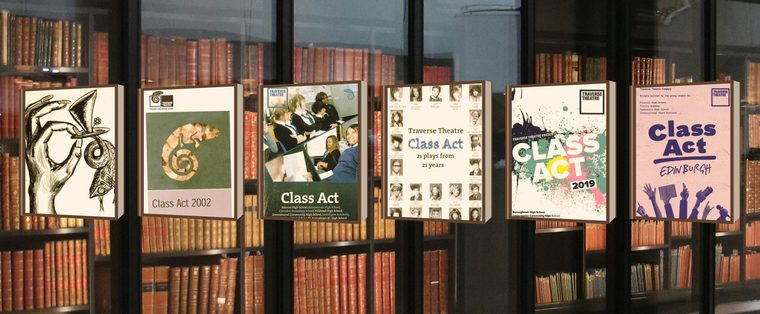
As part of the ongoing research into the history of Class Act, explored in our recent post Class Act: Across Borders and Stages, researcher Maria Kroupnik has been continuing her investigation into the roots of the project through the Traverse Theatre archive and national collections across the UK. What began as a search for context has turned into a small but telling archival mystery — one that sheds new light on the origins of a methodology that continues to shape Class Act today.
Maria’s work has taken her deep into the Traverse Theatre Archive, including materials held at the National Library of Scotland (NLS). Among these was a photocopied newspaper article preserved in the Traverse Theatre Archive collection (Acc. 11865). The article bore a partially obscured date — X9 JUN 1990 — and a clear title: From Jotter to Stage. The author was named as Julie Morrice.
Two subheadings were visible: Scottish review and Youth drama. The publication itself, however, was abbreviated simply as T.E.S. — a tantalising clue, but not a complete answer.
Following a trace
“Archival research does not always begin with certainty. More often, it starts with a fragment, a half-visible stamped date, a heading — and a hunch that something important is hiding in plain sight,” – shares Maria.
Reading the article revealed its importance immediately. From Jotter to Stage reviewed a six-week drama writing project called Writers About engaging pupils from several Lothian schools, culminating in performances at the Traverse Theatre. The process described — improvisation, collaboration with drama teachers, professional playwrights and Traverse directors and actors, and the serious treatment of young people’s writing — felt uncannily familiar.
This was not just a historical curiosity. It was a clear predecessor to what would later become Class Act, articulating many of the same values: trust in young voices, artistic rigour, and sustained collaboration between schools and theatre-makers.
Yet one question remained unresolved: where and when exactly had this article been published?
A puzzle in the archive
With the support of librarians at the National Library of Scotland, Maria began searching the Times Educational Supplement issues from June and July 1990. Page by page, issue by issue, the article refused to appear. The date stamp and subheadings did not align neatly with the available editions, and no trace of From Jotter to Stage could be found in the general TES run.
This absence prompted a new line of enquiry. Could the article have appeared in a Scottish edition of TES, or in a related publication running alongside it? Further research uncovered that Julie Morrice had also written for TES Magazine, suggesting a more complex publishing landscape than first assumed. At this point, the trail led beyond Edinburgh.


South to London
The only remaining place where the mystery could be resolved was the British Library. With the help of the News Media Reference Team in London, Maria was able to consult the Times Educational Supplement Historical Archive in full. There, at last, the article surfaced — fully attributed, dated, and placed.
From Jotter to Stage was published as:
Julie Morrice, “From Jotter to Stage”, Times Scottish Educational Supplement, 29 June 1990, p. 21.
A small discovery, perhaps, but a significant one. The article now sits securely within its historical context, anchored not only to a date and publication, but to a broader narrative about theatre, education, participation and young people’s creative voices in Scotland at the end of the 20th century.
We are currently awaiting a response from the British Library regarding permission to retain a PDF copy of the article in the Traverse Theatre digital archive, ensuring it can be preserved and accessed as part of the living history of Class Act.
Why this matters now?
As explored in Class Act: Across Borders and Stages, Class Act has always been more than a single project. It is a methodology, a set of relationships, and a belief in what can happen when young people’s writing is treated with seriousness and care. Discoveries like From Jotter to Stage help trace that belief back through time, revealing how deeply rooted it is in the Traverse’s practice.
They also remind us that archives are not static. They are assembled through curiosity, collaboration and, often, detective work — and they remain incomplete without the memories and materials held beyond institutional walls.
You can help rebuild the story
As this paper trail makes clear, the history of Class Act — and its earlier incarnation, Writers About — lives not only in libraries, but in people. We warmly invite anyone who has been involved in Class Act (Writers About) since 1990 — writers, teachers, young participants, administrators, parents and supporters — to reach out to the Traverse Theatre with any materials they may still hold. Every photograph, a note or a script extract can help us restore and preserve the project’s history. Your memories, however small, are an essential part of it.
If you have something to share, please get in touch with archive.project@traverse.co.uk
We look forward to hearing from you.
The research project is supported by the Arts and Humanities Research Council [grant number AH/R012415/1].