Maria Kroupnik shares how Class Act continues to travel across borders — connecting young people, artists and researchers through creativity in times of change.
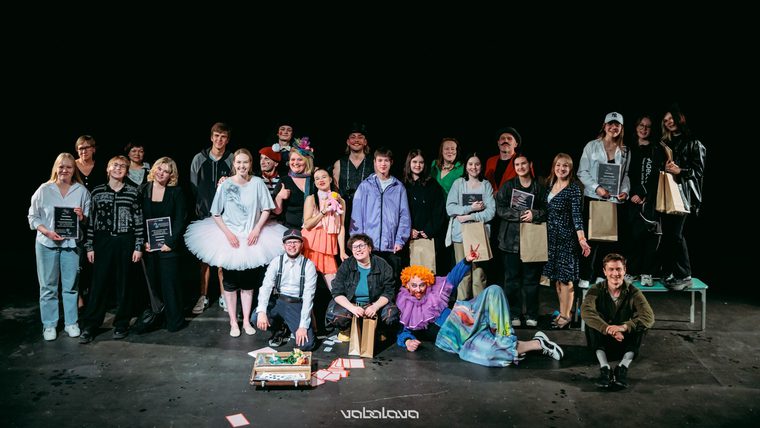
In April, I took part in the annual conference of the British Association for Slavonic and East European Studies, held at the University of Birmingham. There, I convened a two-part colloquium exploring Russian Theatre in Times of Crises – From the Early Soviet Years until Post-2022. On 11 April, the sessions brought together researchers from across the UK alongside Russian scholars currently working in exile in Germany, France and Finland.
Across both panels, the focus was on how theatre responds to – and survives within – moments of political and social upheaval, and how creative practice can open up space for dialogue, reflection and connection.
The event brought together scholars working across different periods and contexts, fostering meaningful academic exchange on theatre, music and other artistic practices under conditions of political and social upheaval.
Theatre of the Emergency: Class Act cases
Alongside convening the colloquium, I presented the paper Theatre of the Emergency: Class Act cases post-2022, reflecting on the history of the project in Scotland, Russia and Ukraine, and how the methodology has been adapted by Russian artists in exile across Europe since 2022. What emerged was a picture of Class Act as something both consistent and constantly evolving – a theatre framework adapted by the people who use it to the contexts in which it is needed most.
You definitely have heard about Class Act Ukraine in Scotland. Through collaboration of the Association of Ukrainians in Great Britain, the University of Edinburgh and Traverse Theatre, it engaged with twelve young Ukrainians from across Scotland and transformed them into storytellers. They received creative support from Scottish and Ukrainian playwrights Natalya Vorozhbyt, Nicola McCartney, and Sara Shaarawi. In a safe space and uniquely supporting environment, they spent five days working-up scripts and developing stories to express themselves. They created new plays that were performed script-in-hand. The showcase happened on Saturday, 13 April 2024. It was directed by Robbie Gordon, Catriona Macleod, and Nicola McCartney, and the cast included Maureen Beattie, Matthew Zajac, Vera Graziadei, Dmitry Everdeen, Michael Dylan, Cindy Awor and Charlotte Driessler. Traverse Theatre published a bilingual anthology and a short documentary film:
The idea was to help participants find like-minded friends and experience shared creativity, while processing their experience of war and displacement in a safe and welcoming environment.
Class Act Finland
The breakout of Russia`s full-scale invasion in Ukraine in 2022 forced numerous creative people and theatre artists into emigration; they left the country in protest and/or out of fear of repressions.
In Helsinki, Class Act Finland brought together displaced Russian-speaking teenagers through a playwriting workshop initiated by theatre pedagogue and researcher Alexandra Dunaeva and playwright Mikhail Durnenkov.
Alexandra shared: “When talking to our colleagues from Fenix Finland, it quickly became clear that displaced teenagers were the most neglected social group, and that they were the ones who needed help and attention when their parents were exhausted and unable to provide them with a culturally rich life. So that's what we decided to focus on”.
With the help of producer Anna Sidorova, the project united forces of the Fenix Finland, a non-profit organisation offering free mental health and psychosocial support in Russian and Ukrainian to the refugees and emigrants, the Cultura Foundation and the National Theatre of Finland.
“Our goal was not to make our participants professional playwrights. We wanted participants to enjoy themselves, find like-minded people and experience the happiness of shared creativity. And we succeeded!” shared Alexandra.
During October- November 2022 in weekly meetings, 13 young Russian-speaking writers (aged 12–17 with roots in Estonia, Ukraine or Russia) worked in the playwriting workshop and wrote 11 plays in Russian and one in Ukrainian, which were presented on 3 December 2022 within the almanack showcase of ‘13 completely new’ at Omapohja stage of the National Theatre of Finland. Martina Marti, a theatre director from Switzerland practising in Finland, became the showcase director. The performance featured Elli Niaria, Maxim Pavlenko, Anastasia Redchuk, Arni Soini and Anastasia Trizna.
Robbie Gordon, who headed the Class Act project in Scotland, delivered a masterclass for local educators and creative practitioners and watched the performances. Later, Traverse Theatre helped to publish the Class Act Finland anthology and deliver it to the young writers. The project has since developed into an ongoing filmmaking lab, continuing to support young people navigating displacement and change.
Class Act Estonia
In Narva, Estonia`s third biggest city, on the west bank of the Narva River, which forms the Estonia–Russia international border, a pilot laboratory at Vaba Lava Theatre explored similar ideas through a socially engaged theatre process. From 29 May to 6 June 2023, the artistic director of the Vaba Lava Narva branch, Julia Aug, invited playwrights Mikhail Durnenkov and Evgeniy Kazachkov, directors Diana Zagorskaya and Nikita Betekhtin, and producer Serafima Kolodkina to deliver the project with the support of the British Council and the Capital of Culture Foundation.
Bringing together 20 teenagers, the project combined playwriting with rehearsal observation, culminating in a showcase and a new anthology of four short plays: 4 plays: “Happiness through Pain”, “Doping”, “This Is My Life” and “An Incident in a Cabaret”.
Nikita Betekhtin, co-director of two plays, noted, ‘It’s pure social therapy, or an urban social project that takes on a theatrical dimension. It is needed to bring people together, to unite not only friends but also relatives... In other words, it is about personal connections, where people temporarily step out of their comfort zones and find common ground for unity.’
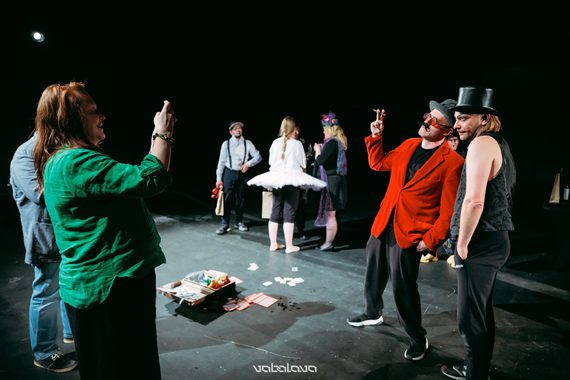
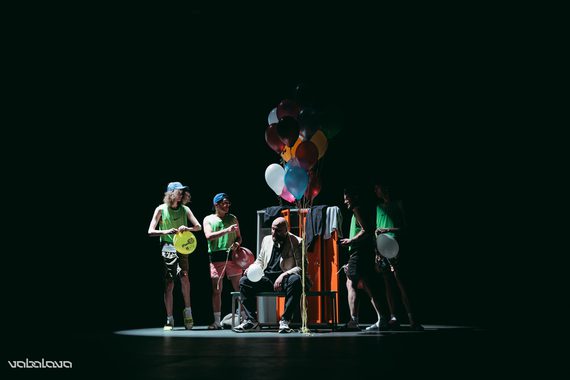
The key here is for the local team to be able to take on board the principles of Class Act themselves. Incidentally, I recently ran a similar project at the Omapohja Stage in Helsinki. In projects like this, people learn to open up and be surprised by what they’re capable of. And we can simply show them how to get there faster and with guaranteed results.
Across each of these projects, a shared thread runs through – creating a safe and welcoming space for young people to meet, to make, to be heard and to practise creative freedom.
Beyond the panels, the conference also opened up opportunities to connect with colleagues from the UK, Europe and the United States, including researchers, poets, writers and translators. These conversations point towards future collaborations and new ways of working across disciplines and borders.
For Maria, the colloquium was an opportunity not only to reflect on Class Act’s reach, but to see how its core values — collaboration, creativity, freedom and care — continue to resonate in new contexts.
As Class Act continues to travel, so too do the stories, voices and connections it supports.
- Maria Kroupnik, Newcastle University
The Arts and Humanities Research Council [grant number AH/R012415/1] support the placement and research project.