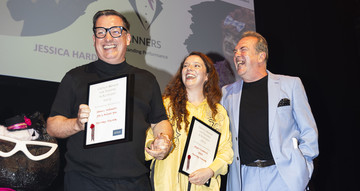
We asked long-time Supporter, audience member and audio describer at the Traverse, Bridget Stevens, some questions to find out more about her work as a pioneer of audio description in Scottish Theatre, as recognised through her recent MBE.

Audio description is a live access service that supports blind and partially sighted audiences to experience theatre. Through a headset, an audio describer narrates key visual elements of a performance, such as movement, expressions, costumes and staging, during natural pauses in the dialogue. This helps audiences build a fuller picture of what is happening on stage.
Bridget has been closely connected to the Traverse for many years as an audience member, Supporter and audio describer. Her work reflects the wider importance of access within theatre and the role venues like the Traverse play in ensuring performances are open to the broadest possible audiences.
You’ve been involved in theatre audio description in Edinburgh for many years. How did you first become aware of audio description and what drew you into the work?
Thinking back to when I first came across an audio describer, I'm not sure that I'd ever heard of audio description. I was in the Festival Theatre, and in the foyer was this person whom I knew with a bright smile on her face. She was just standing there, which is slightly unusual to be standing there on your own with a bright smile on your face. So I bounced up to her and said, “hello, what are you doing here?” And the answer was, “I'm going to audio describe this evening's show”.
So I think that was 25 years ago that I met this woman, was inspired, did the course, and was launched into the world of audio description. And I will never forget my first real audio description - it was in the King's Theatre. At that time, the audio describer sat in a very small room watching a stage on a monitor. It was not ideal, as a fixed camera meant you could easily miss action happening elsewhere on stage.
But I basically enjoyed doing it, and so I signed up and I've been doing it ever since!
From your perspective, how has audio description in Scottish Theatre evolved over the years?
I think there's more in the way of audio description now than there certainly was when I started out. For example, big theatre companies are going to quite small places sometimes, deliberately adapting their shows to suit a village hall in the Highlands of Scotland or remote places that you wouldn't normally associate with arts performance. That's always a fun thing to do as an audio describer, getting to travel with the company to exotic places like Dundee and Inverness!
Other changes are to do with the technology, I would say. I think gone are the days when we would turn up to a theatre in some small place in the middle of Scotland with no certainty at all that the tech would work.
You might argue that another improvement has to do with the promotion of the service. But the problem - and I come back to this again and again - is alerting them to the fact that there are details of access performances available on the internet.
A couple of years ago, during the festival, there were audio described shows on that weren’t getting any bookings. So I started ringing round my list of blind people and telling them one-to-one about shows that were being audio described that I thought they might be interested in. There was a wonderful show at the Traverse last year, My English Persian Kitchen, which I thought was a brilliant show, and nobody had signed up. So I phoned a couple of friends of mine and they came.
But in a way, that's the only way that works, one-to-one approaches. And ideally, it would be from the person who's audio describing the show because they would have an intimate knowledge of the script, and they could share in a way that would tantalise people and persuade them to sign up. But I don't know to what extent other audio describers are willing to do that.
Congratulations on your MBE and recognition as a pioneer of theatre audio description! Was there a particular moment or audience response that made you realise how vital audio description is for audiences?
Well, if I can take the second half of that first, it means a huge amount. It's a great honour, and it was pretty much a surprise, but I feel very honoured to have received it. When I first read the citation which referred to my pioneering work in audio description in Edinburgh, I immediately thought back to the first time I became aware of audio description because it wasn't terribly well known about then.
One of the challenges that we, as providers of this service, have is that it's quite difficult to get feedback from our listeners because we're doing it live, so the show comes down, everybody gets on their coat, and heads off for their bus. But if once or twice we have managed to catch them, they've almost always said, “it was lovely, dear”.
Now, what we really want to know is, “I'd have liked to have known more about Mr. Blogs” and “I'd like to have known more about what was happening in the kitchen”. But it's very difficult to get that out of people because they're basically nice and they don't want to upset you or to hurt you - much as we would love to have constructive criticism.
But we do get feedback because most of us have a lot of blind friends who come to our described shows, and I encourage them to tell me whether it's good, bad, indifferent. I've also become, in the last 10 years, a trainer of audio describers, and we always have visually impaired people on the training team, and that way you get to know them, and then you do get feedback like, “well, that was fine, but an experienced audio describer would have put it this way...”
Audio Description is often talked about as an access service, but for many people it’s about their experience of theatre and belonging. Why do you think access services matter to the arts as a whole?
I mean, I think the whole of August must be a potential nightmare for people with impairments, don't you think? You know, the crowds and all the things that the rest of us love.
But I think adaptations have to be made. Going back to audio description, the live audio description is normally preceded by an introduction. The describer speaks for five or ten minutes, just describing the set and the costumes, maybe saying a few words about the writer and the actors and whatnot. Normally we do that from the audio description box in the auditorium.
But of course, during August, people are coming and going all the time and of course, the issue for the Fringe is that very few of their shows are advertised as being accessible in the programme, because they just don't know in advance.
And something that happens very late in the day, sometimes even in August, is that a producer will suddenly think, “oh, it'd be nice to have our show audio described”. So they get in touch with ADA Scotland, and they say, “we've got this wonderful show in a basement somewhere in the Cowgate, can you provide an audio describer?” and it turns out that there would be no opportunity to see the show two or three times in advance, no equipment and no soundproofing. It's just completely unrealistic.
But then you don't want to spoil the spontaneity of the Fringe! And you want these companies to be doing things. Hopefully we can find a way of helping them understand exactly what’s involved.
You've had a long, meaningful relationship with the Traverse Theatre as a valued audience member, Supporter, and audio describer. How do you feel venues like the Traverse can continue to lead the way in embedding access into theatre?
I think embedding access is a brilliant phrase - that's exactly what it's all about.
I think the Traverse is hugely important for its commitment to new writing. My very first experience of - I think it was the Traverse – was lunchtime shows in a strange place in the Lawnmarket, but there was no seating. You would sit on the floor and you got a hot lunch, and somehow you balanced a hot lunch on your knee and the actors we were sort of in the middle, and people would go in their lunch hour because I think that might have been the original inspiration for A Play, A Pie and A Pint - that people would go in their lunch breaks from working around about.
Then the next move for the Traverse was to the Grassmarket. And my abiding memory of that was the upholstered benches. If you leaned back, you were leaning against the legs of the person in the row behind! The bar stayed open until later than other bars. And again, they were putting on new work and it was exciting. It was very cool to go to the Traverse because I think in those days, other theatres were receiving houses with fairly traditional touring companies - not adventurous things. The Traverse was always exciting, and it was definitely cool to be a member.
To receive information about access shows and how to get involved in the Traverse, sign up to our mailing list!