Often described as the Traverse Theatre’s “best kept secret”, Class Act is far more than an education or playwriting programme. Since 1990, it has enabled young people to see their own stories written, staged and heard in professional theatre spaces, rooted in a belief in trust, care and the power of young voices.
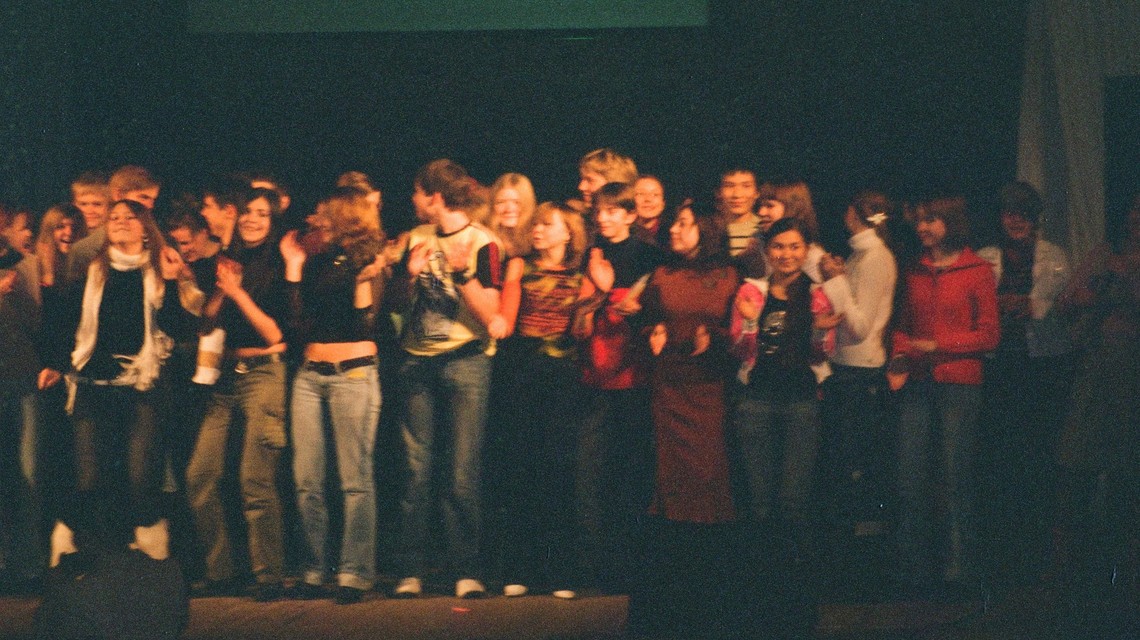
While originating in Scotland, Class Act has had a significant international reach. With the support of the Scottish Arts Council, now Creative Scotland, and British Council the Traverse took the project to Russia in 2004, later extending this work to Ukraine from 2016. Across post-Soviet contexts and beyond, Class Act has supported new writing, creative confidence and long term artistic exchange, often in challenging social and political environments.
Now, as theatre producer, researcher and translator Maria Kroupnik undertakes doctoral research into Class Act, she returns to the project to reflect on its transnational journey and enduring relevance. Her study of the project’s development in Scotland, Russia and Ukraine has prompted the reflections and analysis that follow.
Journey into the Transnational Story of the Class Act Project
When Maria began her PhD at Newcastle University, funded by Arts & Humanities Research Council`s Northern Bridge Consortium Doctoral Training Partnership, she did so with an unusually intimate connection to her subject. She was not simply investigating an educational theatre model—she was returning to a story she had helped shape. For nearly twenty years, Class Act has accompanied her across borders, professional roles and shifting political landscapes, informing her understanding of how young people find their voices through drama.

Maria’s first encounter with the Traverse Theatre’s flagship educational project came in 2005 while she was working in Moscow. At the time, she could not have foreseen how profoundly this short visit would influence her creative and professional life. Three years later, she produced her first Class Act inspired project— Climate Act Theatre — in Moscow and St Petersburg. Working closely with UK playwright Selma Dimitrijevic, she watched Russian teenagers take ownership of their stories, expressing fears, frustrations and hopes with striking honesty. She realised instantly that Class Act was not simply a framework for writing plays; it was a philosophy of empowerment.
A Transnational Creative Journey
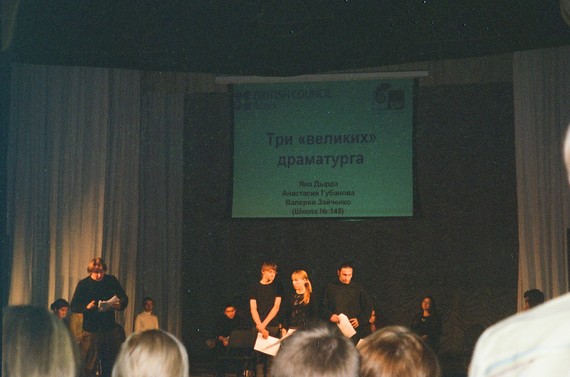
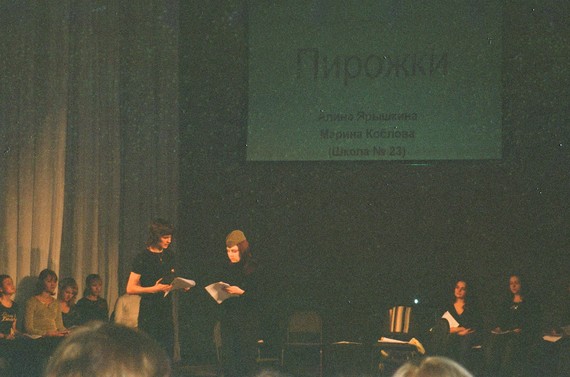
Over the next fifteen years, Maria produced thirteen Class Act and “Teens’ Drama” projects across eight Russian cities, working with more than 200 young people. She collaborated with a wide range of Russian and UK theatre practitioners’, including Mikhail Durnenkov, Evgeniy Kazachkov, Marfa Gorvits, Nicola McCartney, Orla O’Loughlin and Sunniva Ramsay. Many participants went on to careers in theatre, education and social work, demonstrating the project’s lasting impact. These workshops became vital spaces for expression, particularly in regions where young voices were seldom invited into public cultural conversations.
Alongside this work, Maria built a broader career in cultural management and the performing arts. She served as curator and manager of the Lubimovka Independent Drama Festival in Moscow for nearly a decade, oversaw educational programmes, translated and wrote plays, and, since 2022, has coordinated the Russian-language committee of the EURODRAM network. In 2020, she contributed to the Bloomsbury Academic volume New Drama in Russian, analyzing Class Act’s offspring and developments in Russia and Ukraine.
By 2017, she was speaking at the Class Act International Symposium at the Traverse, articulating the project’s cultural significance and its growing international adaptations.
Rediscovering the Story: A PhD with Purpose
In 2023, Maria returned to Class Act with a new purpose, undertaking doctoral research that seeks to restore the fragmented history of the project from its inception in Scotland in 1990 to its later developments in Russia (from 2004) and Ukraine (from 2016).
Her research begins from a clear realization that, despite its 35-year legacy, Class Act has received little sustained academic attention, and its archives—both formal and informal—are scattered, fragile, or in some cases entirely lost. She therefore set out to piece together this history through archival research, interviews, analysis and close study of selected texts written by young participants.
The research draws on multiple disciplines to explore both the development of Class Act and its wider significance. Maria investigates the organisational models that allowed the project to travel across borders; the motivations of playwrights, actors and directors; the values underpinning each iteration; and the socio-political pressures that shaped the work on the ground.
Her enquiries stretch across rehearsal rooms, classrooms, theatre offices and private memory. She traces the evolution of the project’s design and delivery, its shift in tone from country to country, and the ways in which young people in Scotland, Russia and Ukraine used the model to articulate their identities at moments of profound cultural change.
Why Class Act Matters Now
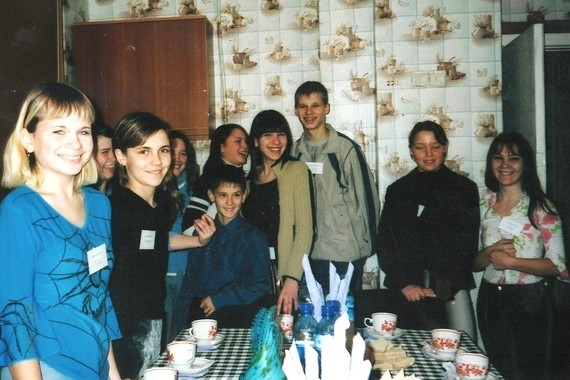
As her research unfolds, Maria is increasingly convinced that Class Act is not merely a collection of playwriting exercises. It operates as a cultural methodology that supports and nurtures freedom of expression, fosters intercultural dialogue, and teaches young people to trust the value of their own voices. Its adaptability has been tested across very different contexts: in Scotland’s evolving educational landscape, in Russia’s changing political climate, in Ukraine’s years of turbulence and war, in newly emerging adaptations in Finland and Estonia working with refugee teenagers as well as Indian (2017) and Gaelic (2018) versions.
These observations shape the core questions at the heart of Maria’s research. What has enabled Class Act to adapt so successfully to such varied contexts? How has it helped young people articulate their identities during periods of international tension? And which of its methods could support future socially engaged theatre practices across borders?
By answering these questions, Maria’s work contributes to wider conversations about cultural memory, peacebuilding, applied theatre and the ethics of socially engaged art. It also seeks to illuminate how transnational cultural exchange — grounded in respect, collaboration and creative freedom—can endure even in times of conflict.
A Call to Help Rebuild the Archive
As part of her research placement with Traverse Theatre and the National Library of Scotland, Maria is working not only to study Class Act’s history but to help preserve it for the future. Many gaps remain in the Class Act archive—missing programmes, flyers, photographs, reports, workshop materials and personal stories that never made it into formal collections.
She warmly invites anyone who has been involved in Class Act (Writers About) since 1990—writers, teachers, young participants, administrators, parents, supporters—to reach out to the Traverse Theatre with any materials they may still hold. Even a single memory, photograph or script extract can help fill crucial gaps in the project’s history.
By sharing these fragments, the wider community can help us piece together the full mosaic of Class Act—a project that has changed lives, crossed borders and shaped cultural identities across generations. Your memories, however small, are an essential part of this story.
If you have something to share please get in touch with archive.project@traverse.co.uk, we look forward to hearing from you!
This work was supported by the Arts and Humanities Research Council [grant number AH/R012415/1]