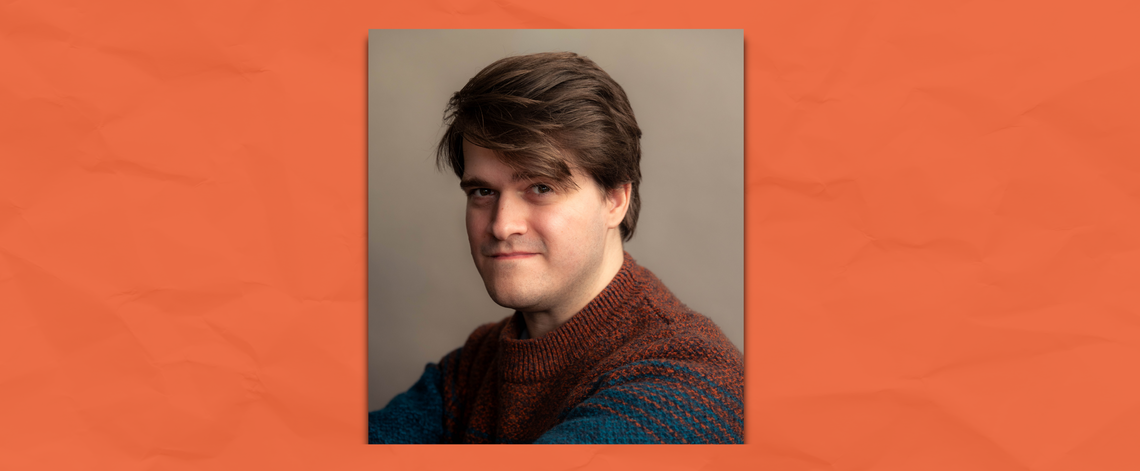
Following the recent announcement of TravFest26 featuring a first look reading of Jack MacGregor's new play Foil, we checked in with them on their IASH fellowship thus far and how the intricacies of fencing are informing their writing process.
"When you make a play about a sport, you set yourself up with a lot of expectations. How will you bring it to life? What makes it theatrical? How do you make people care about the sport and the stakes of the drama? All of these questions are magnified when it’s a niche sport like fencing - which few people understand and even fewer play. The answer for me is going all-in on the ‘promise’ of the play. The promise is basically the audience’s expectations and the play’s dramatic potential. Audiences have an invisible but binding contract in their heads based on things like the title, the poster, and any marketing copy - or sometimes just word of mouth. It takes remarkably little to start building the promise up, another term for it is the hype, or the vibes, you can never predict what it looks like but it is really important. It’s a critical component of the much-discussed Good Night Out; being super intentional about living up to the promise and then really committing to the bit. Don’t pull the punch. Meet the promise and then surpass it.
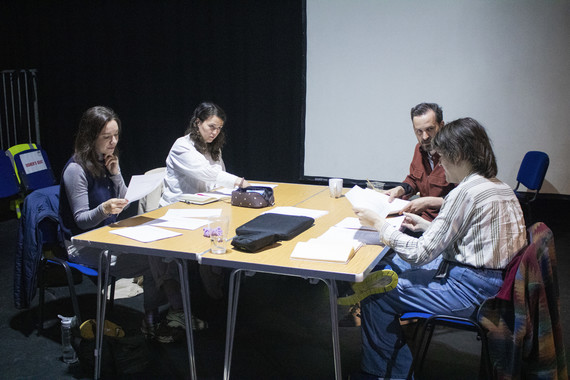
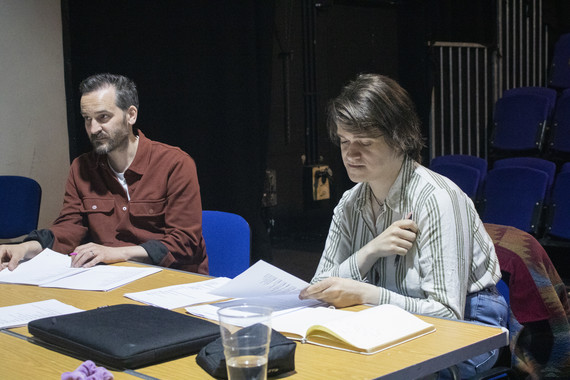
The rivalry in Foil is between two fencers who come from very different worlds. Balancing this relationship has become my focus for the next draft, which will be shared as part of TravFest26. It’s a clash between data and art, hard graft and natural talent. Whether it’s Salieri and Mozart or Nixon and JFK, we are drawn to these conflicts because we have all felt it at some point. I’ve loved writing about the hyper focused culture of professional fencing and having that focus reinforced during our recent R&D. Anna Russell-Martin and Lindsey Campbell brought a brutal and thrilling energy to the characters, they really started to feel alive and that's due to their skill as performers. Gareth Nicholls was great at pushing me for more - stakes, tension, turning the screws on the characters. The ambiguity of the rivalry is really key to this play. I’d love Foil to be a fully theatrical invitation based completely in the aesthetics of professional fencing: a strange world of stark white surfaces, pristine uniforms, obscured faces hiding the rage beneath wire, and framed by a scoreboard that remorselessly tracks the combat between the two rivals.
Part of this play came about from a frustration with sporting narratives. I wanted to get past the surface motivations of athletes we may be used to hearing (doing it for country, community, money) and instead make a character study of obsession, what it means to give your whole life to something like a niche sport, at the expense of everything else, and for it to still not be good enough. You’re not good enough, that you’ll never be good enough, and what that realisation does to someone. All throughout the process I’ve been thinking about examples of work that lean into these ideas: Tár (2023), Black Swan (2010), Whiplash (2014), Foxcatcher (2014). At the highest level of any professional field, when the stakes are really high, the line between obsession and violence is very thin. As I started writing the ideas down, I saw the links between athletes and artists.
It's become a play for anyone who feels defined by their work, anyone who has wanted to succeed so badly - and has lost.
As part of the play’s development, I have been lucky to attend fencing clubs and observe the sport in-person. The best of these collaborations so far has been with The University of Edinburgh Sports Union Fencing Club. The club’s president Irena Waszyrowska has been an incredibly accommodating presence and has tolerated my note-taking in a space of focused training and competition. There are three weapons in fencing; from heaviest to lightest they are epee, sabre, and foils. Each game has their own rules and quirks and at a professional level most fencers specialise in one particular weapon. I immediately latched onto foils. The combination of speed, precision, and decisiveness made me excited to write about it. This was reinforced when I had the honour of watching the UoE Women’s fencing team beat Birmingham in a pretty epic tournament. Watching Irena and the team in action, asking them questions, watching their practice, hearing their chat before and during bouts, all of it has fed into the play in some way - finding the language of that self-contained fencing world is really critical.
I’ve been fascinated by the roots of early fencing as practiced in medieval Spain; where it was called La Verdadera Destreza (the true skill). Early depictions of fencing training are full of these wild diagrams, revealing the alchemic and esoteric character of a sport about the perfection of the body, the power of circles, and sacred geometry. Other fencing traditions like Mensur have fencers fighting maskless to display their tolerance for pain, obtaining grisly scars in the process. Fencing appeals to something ancient and violent and this forms a line of inquiry in the play. It’s been very interesting to see how modern fencing acts as a fusion of antique rules and modern technology.
Finally, writing in the IASH office has been a total privilege. I’ve never had an office before and to come in each week and talk to incredible people makes me the luckiest writer in Scotland. It’s also changed my relationship with workflows - I used to wait around for ‘the moment’ and then write things all at once. Now I write with consistency every single day, no matter if it’s just 100 or 200 words because that is still progress. I think once it’s on the page it has a chance to live, keep your ideas in your head and they’ll die there."