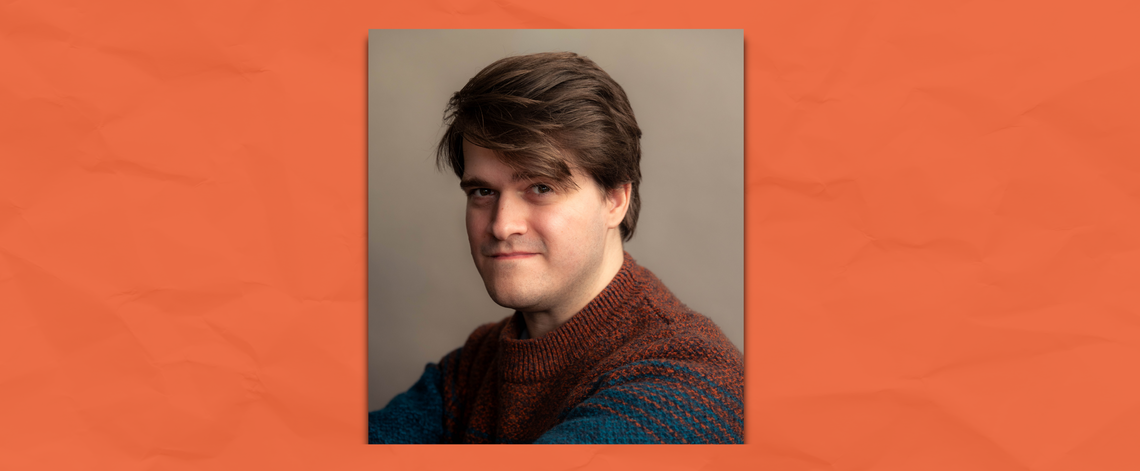
Back in November we announced Jack MacGregor as our 2026 Traverse/IASH creative fellow! Now that they've started their residency we sat down with them to find out more about their career thus far and what they have planned for their fellowship this year.
1. For those unfamiliar, introduce yourself!
I am a writer, director, and dramaturg from Inverness. I’ve recently made the move to Edinburgh after spending most of my life outside the central belt. It is from this other side of Scotland where I draw a lot of my inspiration. My writing explores fringes of contemporary society both within Scotland and in the wider world, seeking to bring the edges into the centre by finding drama in unlikely places; from the forestry estates of the Black Isle and the long winding darkness of the A9, to the deserts of northern Mali and the abandoned the arctic colonies of Svalbard.
2. Can you tell us a bit about the play you’re due to develop as part of the IASH/Traverse playwriting fellowship?
My fellowship will focus on my new play Foil - an anti-biographical sports drama about Olympic fencer Hannah Mayfield and the infamous final match of her career at the 2020 Tokyo Olympics. Framed within the last ten fateful seconds, Hannah confronts the ghosts of her life and the crushing terror of what is about to unfold. Foil is a play about truth, obsession, and what it means to be superhuman.
3. You describe Foil as an “anti-biographical play”, what works have inspired this choice in approach?
Anti-biography is a genre that pivots away from conventional biographical narrative; it is really useful when dealing with conflicting stories and competing ideas of truth. It recognises that all biography is in some way invention, it is an act of omission and curation, to smooth the edges of a life, or exaggerate them, to simply or retroactively assign meaning to events, hammering the past into some meaningful narrative. But life resists narrative - and stories are not always as clear and easy as a Rules for Storytelling book might have you believe. What doesn’t make the cut? How much of a true story is fiction?
Incredible plays like Khalid Abdalla’s Nowhere: An Anti-Biography (which featured at the Traverse during the 2025 festival) have pushed this genre to new heights by exploring the intersection of global historical forces in the lives of oppressed peoples and nations, exploring the colonial aspect of how stories are told and retold. I’m also interested in plays that frame fiction as truth like Stuart Laing’s Confessions of a Justified Sinner or David Keenan and Graham Eatough's This is Memorial Device (which played at the Traverse in April 2024). Rather than being duplicitious, I think this style of work is really exciting and invites the possibility of reality bending magic, saying “this could be real, and so what if it’s not?”. Things that are felt can become true.
4. Your IASH fellowship coincides with the Edinburgh Medical School 300, how do you anticipate this will impact your writing?
It’s a really exciting moment for sure. Three centuries of Edinburgh Medical School, three hundred years of advancing scientific knowledge and pioneering entire medical fields. It speaks to the prestige of this institution in the heart of Scotland’s capital city. As a writer who is not a medical professional, I recognise that my work can only really coincide with this milestone, but I hope my play serves as a compliment to the legacy celebrations this year. I'm very fortunate to be able to pull on the accumulated knowledge of the last three-hundred years of research, they’re the ones who have done the hard work. I see my role as bridging the world of storytelling and the medical humanities, after all this new play is really about the physical and mental limits of human beings - and what happens when they break.
I like spending time with academics, I like hearing about their research, it’s become central to my own process. During my postgrad at the University of the Highlands & Islands, I was surrounded by natural scientists. I shared an office with researchers exploring salmon genealogy, fluvioglacial deposits, and bronze age settlements. I learned that, far from being irrelevant to my own work, these fields were all connected; they are just other kinds of stories.
I look forward to connecting with specialists across the medical humanities, sports science, and psychology through my time at IASH, as well as attending seminars and events marking this special anniversary.
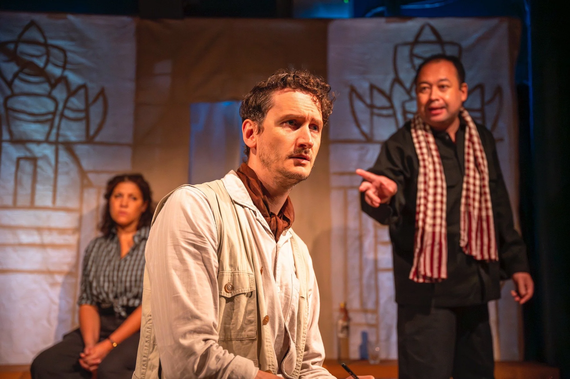
5. Your play, Our Brother, was part of our A Play, A Pie & A Pint season in Autumn 2025 – what was it like having your work on the Traverse stage?
It was an incredible honour. The whole team was brilliant. I get nostalgic about that play and I can just tell it’s going to stay with me for a while. I got really lucky with our director Andrea Ling and our wonderful cast. Right people at the right time, making a story that was challenging and different. Our Brother is one of those plays I’d like to do more with, I don’t think it’s quite done with me. Hopefully I can bring it back.
6. What compels you as a writer?
I really think that plays are meant to be exciting to watch and that theatre in general is meant to be cool and if it’s not doing those things then we’re in trouble. Besides that, any writer is going to feel compelled to write for the times they live in, and this is an inescapable responsibility. I like to imagine each of my plays so far as essentially history plays of the 2020s - that my role when writing drama is to articulate the increasingly violent contradictions that define our world today.
When I write about Scotland I position my writing beneath the veneer of the familiar, within a literary genre I half-jokingly describe as “Deep Scotland”. Basically tapping into the unarticulated landscapes and personalities that appear in the edges of the country, estranged from any prevailing national narrative, the bits that don’t mesh with any of the mainstream stories we tell about ourselves. Usually this means through a different lens of geography, class, and sexuality. Taking our strange country and tilting it on its side, making it feel new and unfamiliar. Anything that is trying to re-examine or tap into aspects of contemporary Scotland that are underrepresented or underappreciated. Sometimes I’ll be out with friends and annoy everyone by coming out with different places that feel like Deep Scotland: “the Cromarty oil rigs”... “RAF Lossiemouth”... “the Auchengeich Miners Memorial”... “Livi Skate Park”... So Deep Scotland. Writers don’t create ‘Deep Scotland’ - it already exists in the world, we just need to recognise and tap into it.
A very incomplete list of plays that fit this category: Fibres by former IASH fellow Frances Poet (which played at the Traverse in October 2019), Gagarin Way by Gregory Burke (which premiered at the Traverse in July 2001), Lost at Sea by Morna Young, Passing Places by Stephen Greenhorn (which premiered at the Traverse in April 1997), and Mouthpiece by Kieran Hurley (which premiered at the Traverse in December 2018). I could list many more but those all feel like super real expressions of this pretendy genre. Play the game yourself. Start pointing it out. It’s ridiculously fun.
7. What’s the best piece of advice you’ve been given as a writer?
Paraphrasing something from Oliver Emanuel: you should always write what you want to, even if it’s weird, even if it makes you scared, or you think you’ll fail, because someone else out there is going to love it. Your writing won’t be for everyone - but it is for someone. The words just need to find them.
That advice kind of changed my life. It certainly changed my writing. It taught me that being distinct is a quality all on its own. In an age of AI slop it’s never been more important to lean into the imperfect human quirks of our own style, that stuff makes each writer special.
8. You talk about being interested in “radical experiments” in your work – what does this mean to you?
For me, radical often means where a story is placed. Going out into the world and talking to people, stepping outside of theatre and challenging myself. Presenting new forms and stories. All the writers I admire use research as an opportunity to be a part of the world and bring the public closer to theatre. It’s a massive privilege to be a writer, to do this as my job, and so I like to make sure it lives in the real world as much as possible. I enjoy seeking strange and unsettling stories, doesn’t matter if it’s former UN peacekeepers or whistleblowers from the forestry sector. There are unarticulated worlds out there, across Scotland and internationally, and I think going out to find them is incredibly exciting.
I want to tell sincere, bold, outwardly looking stories that don’t necessarily need the qualifier of being Scottish or about Scotland in order to be made. We have a proud tradition of internationalist storytelling and I see my work as a contribution to that field.
But sometimes the most radical act (and the most difficult) is to make work despite the challenges - money, time, geography, health. To make things despite it all, even when it seems futile or impossible, to carry a little fire in your hand and just do your best to hold it and protect it.
9. What theatre or cultural experience do you think has most influenced your artistry?
My early experiences of theatre was seeing anything that came up to the Highlands. Touring theatre is the reason I am a writer, it was the only way I could see Scottish plays. This is how I first encountered Dogstar and that connection led to my first play being staged in 2022. Theatre felt like an accessible medium because it just needed a space and some people, it wasn’t like film, it didn’t need expensive cameras. I grew up loving films but couldn’t get the kit. Making wee shows felt more realistic - and I still haven’t shaken that delusion.
What sustained me right at the start - and sustains me still - is being around other artists, particularly other writers. I continue to draw strength and inspiration from previous IASH fellows, either from seeing their work or directly in conversation. This also applies to the wider community of playwrights in Scotland; who are never short on talent and vision, even if we are always short on ways to get our work actually made and put on stage. I mentioned the fire earlier. When that flame is low, and I feel lost, I am helped by my colleagues and friends to find myself again.
10. What are you looking forward to in working with the Traverse and IASH in 2026?
To write something really exciting and super distinct, to write with a new style and form. To grow my confidence to arrive at this new level of work. To not hold back with the ideas and to write a play bursting with real feeling and intent. I think this fellowship is for that, not being scared of seeing where the work travels. Being open to the journey and the responsibility.